
POKER STUDY · 13 MIN READ
How to Study Poker: A Beginner’s Guide to Getting Better
Build better poker study habits with a practical routine for reviewing hands, understanding strategy, identifying mistakes, and improving your decisions across cash games and tournaments.
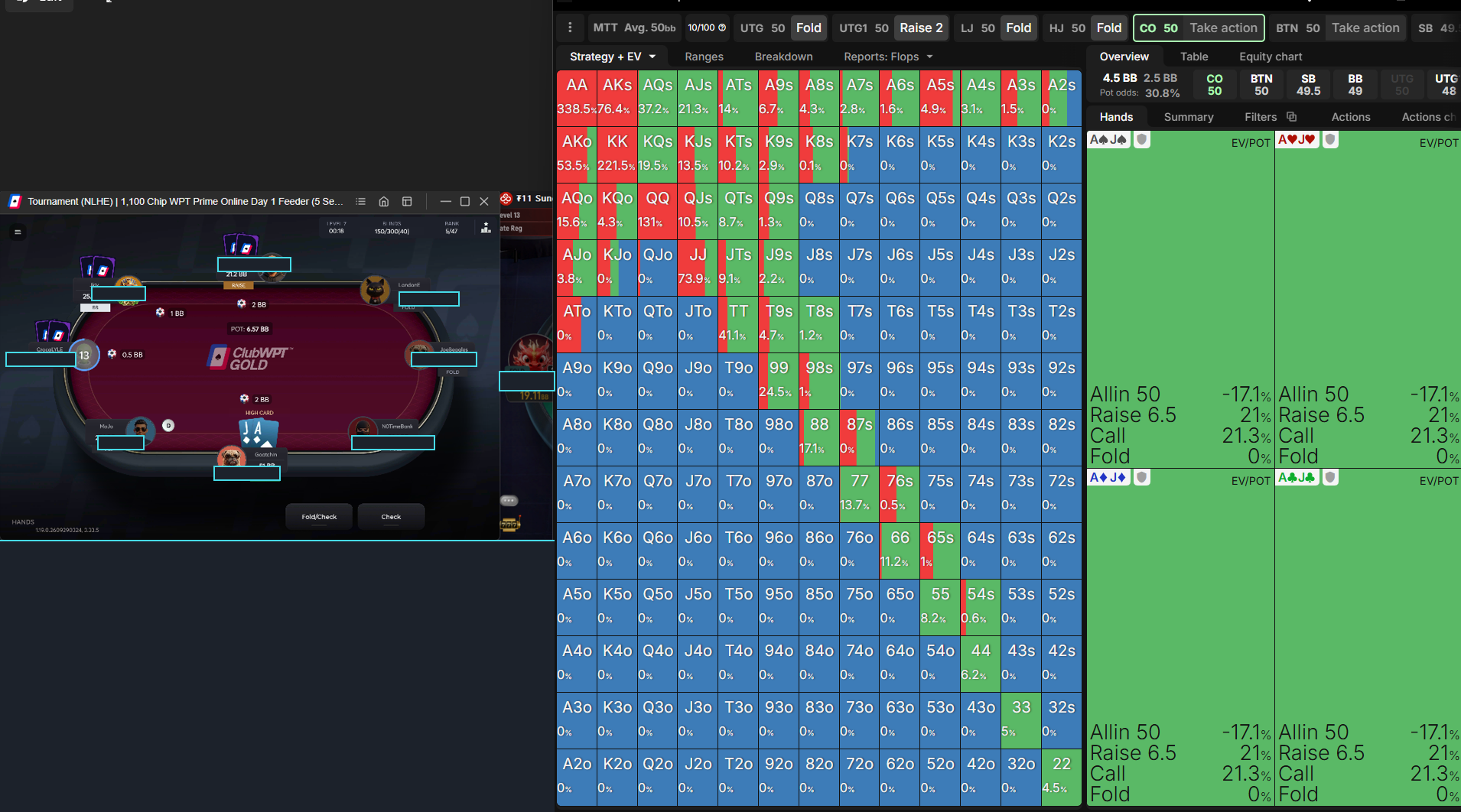
Good poker study is not collecting more content. It is a loop: identify a recurring decision, form an answer, test it off the table, and return to play with one clear adjustment.
Do not open or consult charts, solvers, calculators, or study tools during active poker play. Follow every poker site’s software policy; Telemetry Poker applies the stricter off-table-only standard throughout this guide.
Start with preflop and basic math. Review marked hands next. Add solver work and ICM after you can describe the spot accurately. Advanced software cannot rescue vague questions.
This guide is aimed at beginner and intermediate online MTT players, where changing stack depths and payout pressure are constant. Live players can use the same routine with written hand notes, and cash players can replace ICM work with rake, deeper-stack, and pool-specific study.
FOUNDATION ONE
Learn preflop by position and stack depth
Preflop decisions happen every hand, so small leaks repeat quickly. Learn a baseline for unopened pots first: which hands to open from each position at common depths. RFI means Raise First In—the first voluntary preflop raise in an unopened pot. An RFI chart covers that specific decision; it does not analyze later preflop action or any postflop street. Then add responses to opens, 3-bets, reshoves, and limps.
Compare early, middle, cutoff, button, and small-blind ranges.
Separate calls, 3-bets, and folds by position and effective stack.
Practice jam, min-raise, raise/call, and reshove decisions at 10–30 BB.
Do not memorize a chart as universal truth. Ante size, rake, opening size, payout pressure, format, and opponent behavior change the best response. Treat ranges as a baseline and record the assumptions behind them.
FOUNDATION TWO
Use a small set of poker math repeatedly
Suppose the pot is $50 and an opponent bets $25. If you call $25, the final pot is $100: the original $50, the opponent’s $25 bet, and your $25 call. Your break-even equity is therefore $25 ÷ $100 = 25%, assuming no rake, no further betting, and full equity realization. Real hands may require adjustments when any of those assumptions does not hold.
Your share of the pot on average against a hand or range.
The probability-weighted average result of an action over repeated trials.
How many specific holdings can make up a range after accounting for known cards.
Effective stack divided by the pot entering a street; a compact guide to how committed stacks can become.
Estimate first, calculate second. The goal is to improve intuition, not to outsource every decision.
THE CORE OFF-TABLE HABIT
Collect hands safely, then review them in layers
After the session, open hands saved by the poker client or use its built-in replayer to revisit marked decisions.
Where the poker site’s rules permit it, you may capture the screen during a hand at the decision point you want to remember. Save it for review only after the session, and mask player names and other identifiers before public sharing.
Where the operator supports downloads, save the official history file and import or annotate it off-table.
Tracking or import software can collect histories only when the specific poker operator permits it. Check the current policy first.
A permitted screenshot is a note for later—not permission to consult a solver in real time. Never use prohibited overlays, automation, screen-reading, data capture, or real-time assistance. Follow the operator’s current rules.
- 01Reconstruct the facts
Positions, effective stacks, blinds and antes, action, sizings, board, payouts, and reads. Do not begin with the result.
- 02Name the decision
“Should I call?” is too broad. Ask which range bets this size, what worse hands continue, or how payout pressure changes a reshove.
- 03Reason without software
Write your range estimate, pot odds, alternatives, and prediction before viewing output.
- 04Use the right tool
An equity calculator answers equity questions. A solver compares strategies under specified assumptions. An ICM tool estimates prize-equity pressure.
- 05Save one takeaway
Turn the review into a short rule you can recognize in the next session, then revisit exceptions later.
For live hands, record the spot immediately after play without identifying other players. If exact suits or sizings are uncertain, mark them as estimates rather than manufacturing precision.
GTO WITHOUT THE MYSTIQUE
Learn the logic before the frequencies
Game theory optimal strategy is a model of balanced play under defined assumptions. It gives you a benchmark: how ranges, board texture, position, stack depth, and bet size interact when opponents respond well. It is not a command to copy every mixed frequency against every real player.
What the model teaches
Range advantage, nut advantage, equity realization, bluff/value composition, and how strategy changes across runouts.
What you still decide
Whether the assumptions resemble your game and which observed mistakes justify a simpler exploit.
When studying a solution, ask why a hand class prefers an action. Group hands by properties—strong value, draws, blockers, showdown value—not by isolated colors in a grid. GTO Wizard’s official help describes Study Mode as a way to browse solutions from preflop through river; its free and paid access limits can change, so confirm the current plan before subscribing.2
TOURNAMENT-SPECIFIC STUDY
ICM turns stack distribution into prize pressure
Chips have direct strategic utility, but tournament payouts are nonlinear. Near bubbles, pay jumps, final tables, and satellite qualification, losing a stack can cost more prize equity than an equal chip gain adds. ICM estimates that relationship using stacks and payouts.
Pressure depends on who covers whom, the short stacks, future blinds, position, payouts, and opponent ranges. Big stacks can often apply pressure; covered middle stacks may need to avoid collisions; short stacks still must take profitable opportunities.
Start with common spots: button or small-blind shoves, big-blind calls, final-table reshoves, and satellite bubbles. Compare chip-EV and ICM outputs to see which hands move most and why. Tools are for off-table analysis; follow the poker room’s rules and never use prohibited real-time assistance.
A ROUTINE YOU CAN REPEAT
A practical 30-minute study session
Pick a marked hand or one recurring spot. Write the relevant facts and your first answer.
Build both players’ ranges, calculate pot odds, and identify effective stack and payout context.
Use an equity calculator, range library, solver, or ICM calculator that matches the question.
Group hands, compare actions, and explain the result without referring to colors or percentages alone.
Write one takeaway, tag the leak, and choose a related drill for the next session.
Three focused sessions per week will usually teach more than one long, unfocused binge. The best schedule is the one you can repeat while still playing enough to generate real questions.
VERIFIED STUDY TOOLS
Start free; pay only for a specific bottleneck
Equilab Online is a free browser-based equity and range calculator for desktop and mobile; Equilab Classic is the free original Windows version. Both include the equity calculator, Scenario Analyser, and Equity Trainer. Use them only after play and follow each operator's software rules.
Official Equilab Online and Classic page →Web-based heads-up push/fold charts and an ICM equity calculator.
Official free tools →Browser-based study, practice, and analysis. Free limits and paid tiers change; check the official product and help pages before choosing a plan.
Official GTO Wizard site →Tournament preflop, push/fold, ICM/FGS, replayer, and training features. The official pricing page lists free and paid access; subscription terms can change.
Official ICMIZER pricing →Cash and tournament simulations that help visualize confidence ranges and downswings. Model output is illustrative, not a prediction.
Tournament variance calculator →Telemetry Poker has no stated affiliate relationship with these tools. Features, prices, platform support, and usage rules can change. Verify current terms and your poker room’s software policy before use.
MEASURE THE PROCESS
Track what you studied, not just what you won
Example: big-blind defense errors found per review, or quiz accuracy in 15 BB reshove spots.
Hands reviewed, drills completed, or focused study minutes per week.
ROI, bb/100, hourly rate, or tournament results—interpreted with sample-size caution.
Build a simple leak log with the date, game, stack depth, spot, current hypothesis, source checked, takeaway, and revisit date. Results matter, but short-term results are noisy. A session can be well played and lose; a mistake can win.
THE BOTTOM LINE
Make the next decision easier to recognize.
Choose one recurring spot. Estimate first. Check with the narrowest useful tool. Write one takeaway. Return to play, collect evidence, and repeat.
Keep the playing record beside the study record. Use the free Telemetry Poker tracker →
SOURCES & FURTHER READING
Primary tool and learning references
- 1PokerStars Learn — Beginner’s Guide to Poker (PDF)
Foundational rules, position, and beginner strategy concepts.
- 2GTO Wizard Help — Study Mode
Official explanation of browsing GTO solutions and study metrics.
- 3PokerStrategy — Equilab
Official feature and use-policy page for the free equity tool.
- 4HoldemResources — Free Tools
Official free push/fold and ICM resources.
- 5ICMIZER — Plans and Pricing
Official current free and paid feature descriptions.
External pages were checked on October 20, 2026. We link to official product or publisher pages and avoid quoting temporary prices in the article body. The routine and learning sequence are editorial guidance, not a promise of profit or improvement.