

Why Is Everyone Playing So Crazy in Mystery Bounty Tournaments?
Because once the bounties switch on, chips can buy more than a path up the payout ladder. They can buy chances at prizes hiding behind the next knockout—and that changes the value of every all-in decision.
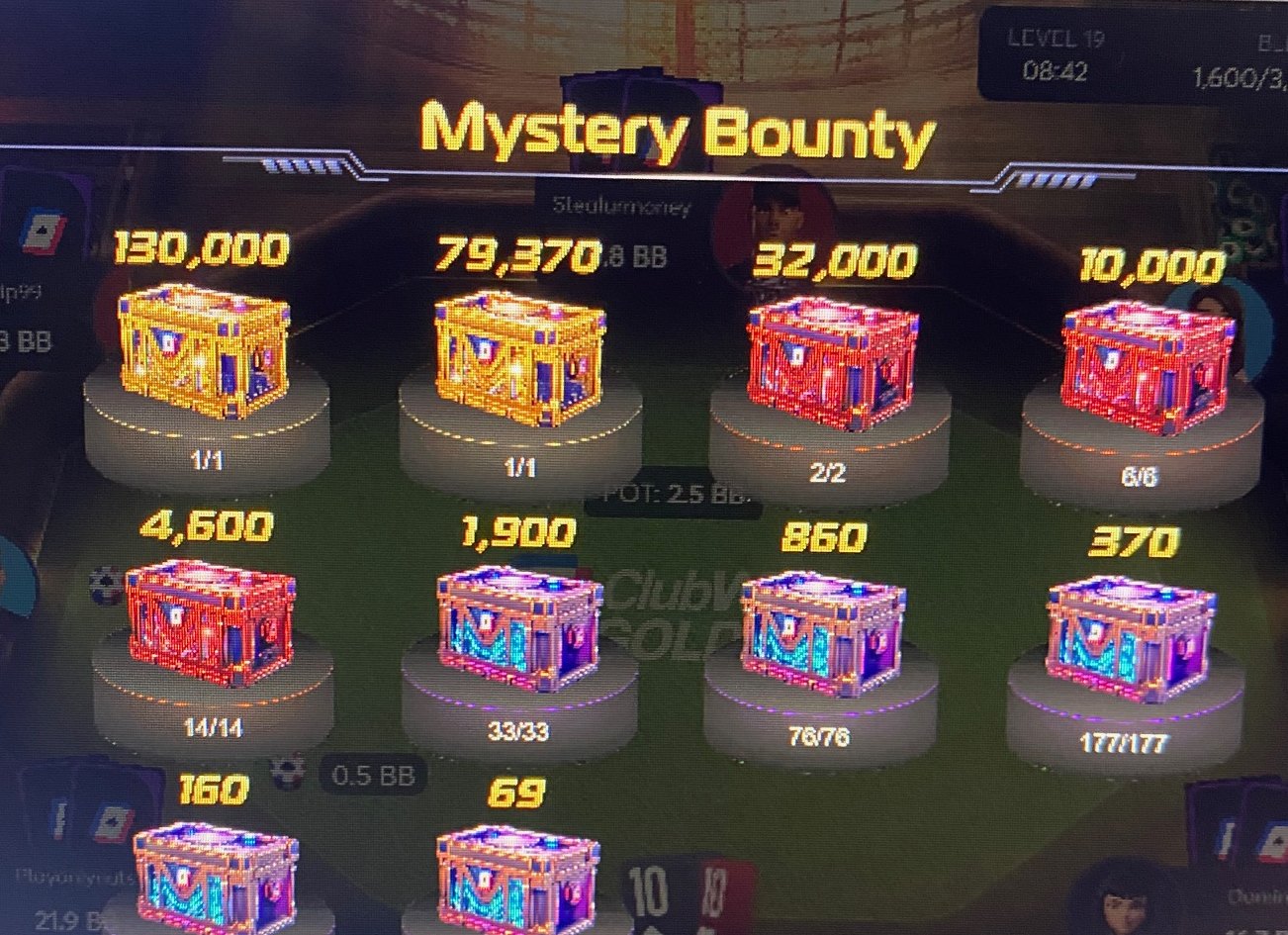
A mystery bounty tournament can look like ordinary poker right up until it suddenly doesn’t. A player jams. Two people call. Then a third player comes along—even with a hand that would be an easy fold in a regular MTT.
That action is not automatically reckless. When bounties are active, eliminating a player can pay an immediate prize on top of the value of the chips in the pot. The right question is no longer only, “How often does my hand win?” It is also, “What is the expected value of the bounty I can claim, and how often do I actually collect it?”
A bounty is additional value, not permission to ignore stack sizes, side pots, position or tournament life. Add it to the equation; do not let it replace the equation.
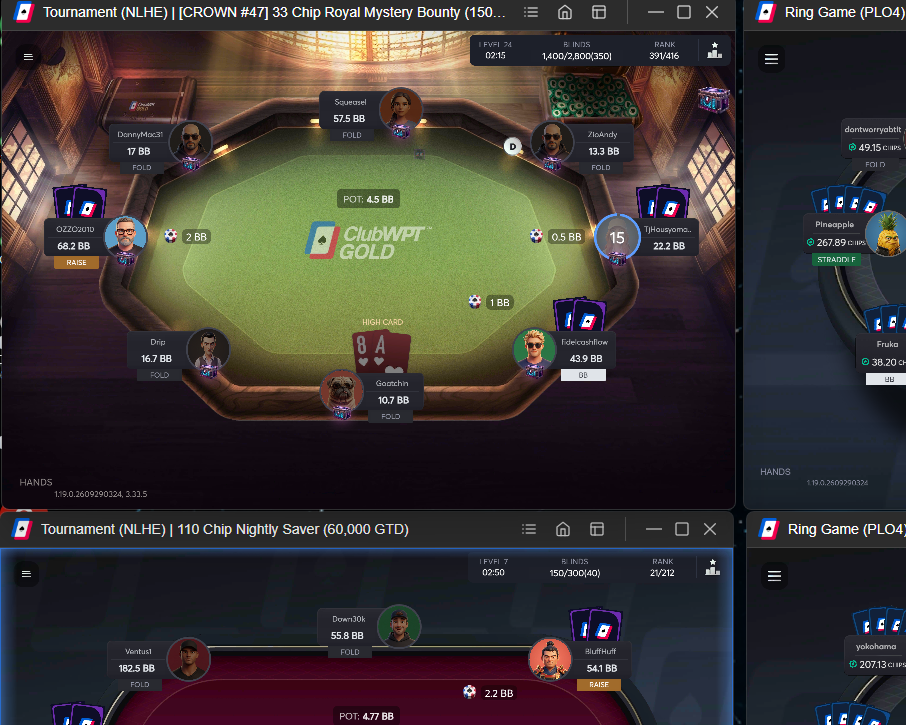
Image attribution and non-affiliation: The two ClubWPT Gold gameplay screenshots were supplied by the author and are used for independent educational commentary. Telemetry Poker is not affiliated with or endorsed by ClubWPT Gold. ClubWPT Gold names, marks, and interface elements belong to their respective owner.
First, know which game you entered
“Bounty tournament” is a family of formats. The labels matter because the prize attached to a knockout—and whether you can know its value before acting—changes your decision.
| Format | Knockout value | What changes strategically |
|---|---|---|
| Regular MTT | No separate bounty | Chip accumulation and survival serve only the finishing-position prize pool. |
| Fixed bounty | Known, usually constant | The immediate prize can justify wider calls when you cover the all-in player. |
| PKO | Known and grows | Part is paid now and part increases the winner’s own bounty; large displayed bounties become magnets. |
| Mystery bounty | Hidden draw from remaining prizes | Use the average remaining bounty—not the headline jackpot—as the starting estimate. |
| Satellite | Usually seats, not laddered cash | Survival can dominate chip EV near qualification. We’ll cover this in a dedicated follow-up. |
What “mystery” actually means
Operator rules vary. Commonly, the tournament has an initial stage with no bounty awards and a later stage when knockout prizes activate. PokerStars says its final stage usually begins after the money bubble and shows remaining prizes in a Tournament Info widget. GGPoker says single-day events activate at the in-the-money stage, while phased events activate in the final phase. PokerStars Help ↗ GGPoker Help ↗
Verified ClubWPT Gold note: its support guide describes a pre-bounty initial stage and a final stage—typically ITM, Day 2, or a stated blind level—where a qualifying knockout reveals and automatically credits a hidden Chip bounty. Always check the lobby for the event in front of you; the stage trigger and prize mix can differ. ClubWPT Gold Support ↗

A claimed chest changes the pool for the next decision
About the authentic screenshot: This is a $218 buy-in ClubWPT Gold Mystery Bounty tournament, and the $1 million guarantee was exceeded.
Turn the remaining bounty board into an average
Use the bounties still available—not the original board—and the full net prize-pool contribution from one entry, excluding the fee. This is a simplified comparison heuristic, not an exact chip-EV, ICM, or GTO threshold.
- 01 Remaining bounty pool
- Add the cash value of every bounty award that can still be drawn.
- 02 Remaining bounty awards
- Count the awards still available. Pool divided by awards gives the average bounty.
- 03 Starting-stack conversion
- Divide the starting stack by each entry’s full net prize-pool contribution, excluding fees, to estimate chips per dollar.
- 04 Current big blind
- Divide the chip equivalent by the current big blind to express the benchmark in BB.
Hypothetical event—not the ClubWPT Gold event pictured above: imagine a $33 buy-in with a $3 fee, a $30 net prize-pool contribution, and a 10,000-chip starting stack. At the decision point, $50,000 remains in the bounty pool and 734 qualifying awards remain. This simplified example assumes cash awards, equal draw probability, and accurate remaining-pool data; a real decision must follow the operator’s live rules.
$50,000 ÷ 734 = $68.12
Using the full $30 net contribution, the $68.12 average bounty is equivalent to approximately 22,707 tournament chips. With the big blind at 1,000, that is 22.71 big blinds.
$68.12 ÷ $30 × 10,000 ≈ 22,707 chips
22,707 ÷ 1,000 = 22.71BB
Illustrative no-ante hand44.9% → 23.3% simplified threshold
How the bounty overlay changes the hands worth considering
Both grids use the same deliberately tight hypothetical button shoving range: 77+, ATs+, KQs, AJo+ (104 starting combinations before Hero’s blockers). This is not a solver-derived GTO range or a recommended calling chart.
44.9% required equity
Hands whose exact all-in equity meets the ordinary pot-odds threshold.
23.3% simplified threshold
Gold cells are hands that newly clear the lower illustrative threshold.
The educational point: adding meaningful bounty value can dramatically expand the set of hands worth considering for a call. Here, only 10 of 169 hand classes clear 44.9%; 158 more clear 23.3%, while 72o remains below both.
Exact equity method: each hand class was compared with every class in the stated shoving range using exhaustive-board preflop matchup equities, then weighted by the exact number of legal, disjoint suit combinations. Card removal is therefore reflected in the range average. Ties count as half the pot.
Illustrative—not GTO: real calls also depend on whether Hero is eligible to win the bounty, the opponent’s actual range, coverage and side pots, payout structure, ICM, future stack utility, and operator rules.
Hero has 65BB in the big blind. The button shoves 12BB, the small blind (22BB) folds, and Hero has already posted 1BB, so the incremental call is 11BB. With no antes, the pot is 13.5BB before Hero calls and 24.5BB after the call. Hero covers the button and is the only caller.
Simplified heuristic—not an exact chip-EV, ICM, or GTO threshold: under this hand’s stated geometry, the non-bounty threshold is 11 ÷ 24.5 = 44.9%. Adding the 22.71BB comparison value gives 11 ÷ 47.21 = 23.3%. The bounty is not paid in tournament chips, and 22,707 chips is only a conversion aid. Whether Hero actually earns a bounty depends on the operator’s rules and the pot result; split pots, side pots, payout pressure, future bounty access, and imperfect equity realization can all change the decision.
The tournament changes in chapters
Before bounties activate
Play resembles a regular MTT. Build a stack, but do not pay a bounty premium for knockouts that award nothing.
Near the activation line
Future bounty access gives survival extra option value. A stack that reaches the next stage can contest every bounty still in the pool.
Bounties live
Short stacks become valuable targets. Calls can widen, but only when you cover the player and can win the pot that eliminates them.
Late and final table
Big payout jumps push back. Compare bounty EV with the real money you risk by busting or losing leverage.
Covering is a hidden superpower
You can only eliminate a player whose full stack you cover. That makes a big stack more than a pile of chips: it is a portfolio of knockout opportunities. Against shorter stacks, you can win both their chips and a draw from the bounty pool. They cannot eliminate you in one hand.
But “I cover” is not the same as “I should call.” In a multiway pot, you may beat the bounty player yet lose the relevant pot to another opponent. Side pots matter. So does the possibility that doubling a dangerous stack costs you future bounties and table control.
When a huge prize is still showing, every player sees the same jackpot. Your edge comes from pricing the whole pool—not daydreaming about its brightest number.
Where ICM pushes back
Independent Chip Model (ICM) estimates how stacks translate into shares of the remaining finishing-position prizes. Near big payout jumps, losing chips generally hurts more than winning the same number helps. Bounty value pulls toward gambling; ICM pressure pulls toward survival. Strong decisions compare both forces.
That tension is sharpest when a call could leave you crippled, when several shorter stacks may bust soon, or at a final table with steep jumps. A modest average bounty rarely compensates for torching a valuable stack on the wrong side of a large pay jump.
Five expensive mistakes
- Using the top bounty as your expected value.Weight every remaining prize by its frequency.
- Chasing before bounties are active.Confirm the exact trigger in the tournament lobby.
- Forgetting who covers whom.No cover, no immediate knockout prize.
- Ignoring other callers.Your hand must win the relevant pot, not merely beat the short stack.
- Treating every stage alike.Early chip EV, bounty EV and late ICM do not carry equal weight.
A six-second mystery bounty checklist
- Are bounties active?
- Do I cover the all-in player?
- What is the average of the remaining bounty pool?
- What is my equity—and is the pot multiway?
- What payout jump or future leverage am I risking?
- Would I make this play if the jackpot graphic were hidden?
So, why is everyone playing so crazy?
Some players are making sound adjustments. Some are overreacting to the reveal animation. Mystery bounty poker rewards controlled aggression: estimate the prize you can actually expect, understand whether you can claim it, then balance that value against the cost of losing tournament chips.
The format is volatile by design. Your decisions do not have to be.
Keep the format, buy-in, and result attached to the same record: use the free Telemetry Poker tracker →.
Sources & Further Reading
- ClubWPT Gold — Mystery Bounty TournamentsPrimary operator support; stages, hidden Chip bounties and crediting.
- ClubWPT Gold — Understanding Tournament TypesPrimary operator comparison of standard, PKO and mystery bounties.
- PokerStars Help — Mystery Bounty TournamentsPrimary operator rules; stages, pool split, multiple KOs and split pots.
- PokerStars — Tournament RulesRelevant pots, side pots and bounty awards.
- GGPoker Help — Mystery Bounty FAQPrimary operator rules for single-day and phased events; cash and non-cash prizes.
- PokerStars Learn — How Mystery Bounty Tournaments WorkOperator editorial overview and on-client reference screenshots.
Rules and interfaces change. Confirm the lobby and operator terms for the specific tournament before play. Strategy discussion is educational, not financial advice.