
TOURNAMENT STRATEGY · 12 MIN READ
Maximum Late Registration in Online MTTs: Volume, ROI & Variance
Registering near the deadline can compress a tournament into fewer hours and make a larger schedule manageable. Some structures yield only 8–10 BB, while others provide more; always calculate the actual lobby stack against the current blinds.

Maximum late registration means entering an online MTT near the end of its registration window. A typical late entry may begin with only 8–10 big blinds, so the trade is direct: fewer early-level hours and more schedule capacity in exchange for less maneuvering room, more all-in exposure, and greater short-term variance.
A player can earn less per event but potentially more per hour if shorter tournament time permits more volume. Neither result is automatic; both depend on structure, skill by stack depth, field size, fees, and format.
Registration rules are event-specific. The lobby controls the deadline, stack received, blind level, re-entry availability and payout state. Do not assume a fixed share of the field has already busted: a small nightly event, a large Sunday major and a satellite can look completely different at the deadline. Read the live tournament lobby before registering.
WORKED STACK EXAMPLE
Convert the actual lobby stack into big blinds
Suppose a late entry receives 8,600 chips while the big blind is 1,000:
This is a very short starting stack. Before registering, also check the ante, level length, and next blind level—the stack can become effectively shallower within minutes.
This is arithmetic, not strategy advice. The same calculation should use the live lobby numbers for the specific tournament.
WHY EXPERIENCED ONLINE MULTITABLERS USE IT
Build the session around registration-close times
Add events when space opens
Instead of loading every event at its start, a player can list each registration-close time, watch the active table count, and add a max-late entry after bust-outs create enough screen space and attention.
Compress each entry
Skipping low-blind levels reduces hours invested in each event. If the resulting loss in per-entry ROI is modest, expected hourly profit may improve—but that must be measured, not assumed.
High-volume online players often treat the lobby as a schedule rather than a list of start times. They may skip early levels, sort candidate tournaments by registration close, and stagger entries so the table count stays inside a personal decision-quality limit. That can turn freed screen space into another tournament later in the session and increase weekly entry volume without creating the same opening-hour pileup.
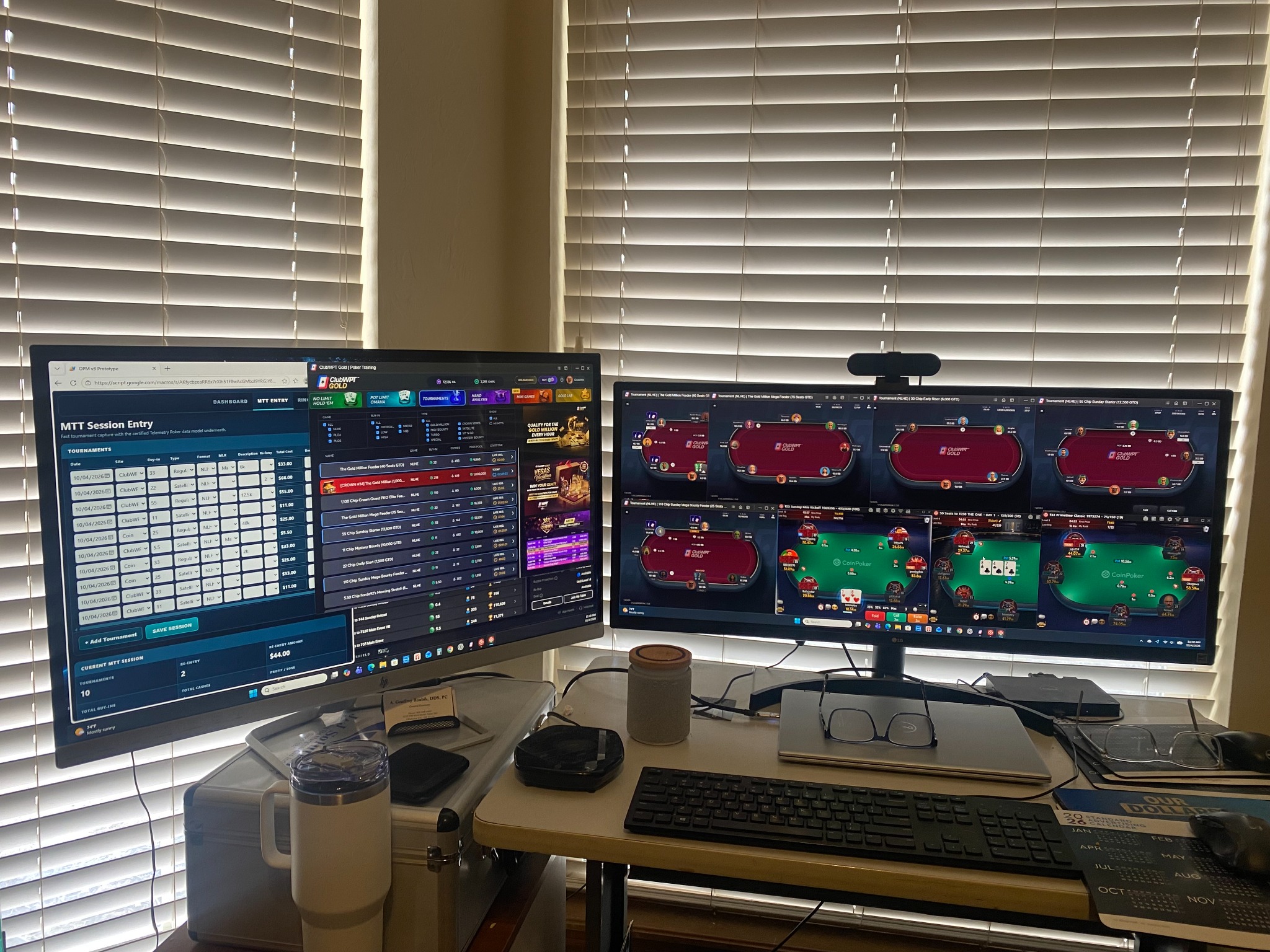
The useful comparison is not simply “Which entry has the highest ROI?” It is expected profit per hour across the whole session. A shorter entry with lower per-entry ROI can still contribute more hourly expected profit if it fits extra volume into otherwise unused time; it can also hurt the session if short-stack decisions overload the player or reduce the quality of play on every table.
The benefit is opportunity cost, not free tournament equity. Entering early still offers deeper stacks, more postflop decisions, and more chances to exploit weak deep-stack play. A player with a strong early-stage edge may give up meaningful value by waiting.
THE 8–10 BB REALITY
Closer to the payouts, but under immediate pressure
A major benefit of maximum late registration is that much of the original field may already be eliminated, so a new entry can begin materially closer to the payout threshold than an entry at the opening level. That is a time and distance advantage—not proof of a higher cash probability or better ROI.
At roughly 8–10 BB, there may be little room to raise and fold, defend loosely, or navigate multiple postflop streets. Antes accelerate the pressure. Many decisions become jams, calls, or folds, and a single incorrect range assumption can end the entry. Starting short does not automatically make cashing more likely: the entrant may have less survival time, less fold equity, and fewer chances to recover from a mistake.
A shorter average event duration can increase the number of tournaments played across a week or series.
You surrender early deep-stack opportunities and begin with less flexibility. Strong short-stack play can narrow that cost, not erase it.
A larger share of your entry outcome can hinge on a small number of preflop confrontations, widening short-term swings.
ICM may already matter if the field is near a bubble or if satellite seats are approaching, but proximity to the money does not automatically make an entry profitable. Check places paid, players remaining, stack distribution and the next blind increase. Re-entry also changes risk: a fresh late stack can be useful, but every bullet increases total cost and bankroll pressure.
FORMAT FIT
Some tournaments suit max late registration better than others
- 01Standard MTTs
Often the cleanest candidate because the prize pool is driven by finishing position rather than bounties already won. Suitability still depends on starting BB, field size, payout stage and your short-stack edge.
- 02Mystery bounties
They may suit late entry when the bounty phase has not started and every remaining player still has access to the same future envelope pool. Check the exact phase rules; entering after bounty opportunities begin changes the calculation.
- 03Satellites
Late entry can be attractive when the remaining stack retains meaningful seat equity and the event is approaching qualification pressure. Seats awarded, entries remaining, average stack and transferability rules matter more than a generic BB cutoff.
- 04Traditional bounties: generally poor max-late candidates
Under an explicit no-reentry structure where 50% of each entry funds a fixed bounty, if 75% of the original field has been eliminated and each elimination has paid one bounty, 37.5% of the initial total entry money has already left through bounties (50% × 75%). This is an illustration, not a universal figure: fees, re-entries, bounty rules, and the actual elimination pattern change the amount.
- 05PKOs: survivors retain value, but coverage is scarce
Progressive knockouts preserve some accumulated bounty value on surviving players, unlike fixed bounties already removed from the event. Even so, an 8–10 BB late entrant may cover few opponents and have limited access to that value. Consider entering a PKO earlier with roughly 40 BB or more when bounty capture is central to the plan; that is a practical heuristic, not a guarantee or a universal cutoff.
Field size changes every category. In a huge field, a late entry may still be far from the money with many short stacks in play. In a small field, the same registration clock may place you near a bubble with immediate ICM pressure. Never treat elapsed time as a substitute for current field data.
FEATURED REAL-DATA EXAMPLE
Satellite results, split by registration timing
This authentic Telemetry Poker Registration / MLR view isolates one tournament format—satellites—and then compares registration timing within that format.
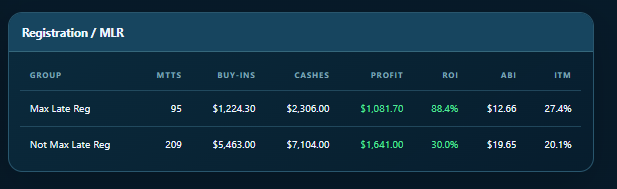
Telemetry can filter registration timing inside a specific format, making comparisons like this possible. Even a smaller sample can begin to reveal a pattern worth tracking, while confidence improves as the sample grows. These unequal samples do not prove that maximum late registration caused the difference; ABI, site, field strength, structure, game selection, runouts and player decisions may also differ.
Profit divided by buy-ins. It is useful but noisy here, and the two groups still differ in ABI.
The screenshot does not measure hours. Compare long-run profit with the time each group occupies and its effect on the rest of the session.
Keep the same format and timing filters as more tournaments accumulate; a larger sample can make the comparison more reliable.
Seats awarded, players remaining, stack distribution and qualification pressure all shape the result.
Use Telemetry Poker to filter registration timing within a specific tournament format, then keep sample size, ABI and structure in view. Open the Telemetry Poker tracker →
A PRACTICAL MAX-LATE-REG CHECK
Use current tournament data, not a slogan
Before clicking register, verify the short-stack plan.
Calculate the exact starting BB, check antes and the next level, note players remaining and places paid, identify the format, and confirm how many tables you can manage without degrading decisions.
- 01Know the 8–10 BB ranges
If the entry begins this short, your first orbit may contain a shove, call or reshove decision. Study those ranges off-table before choosing this schedule.
- 02Control table count
Add the event only when current tables leave enough attention for high-leverage decisions. More volume is useful only if decision quality remains acceptable.
- 03Separate ROI from hourly rate
A lower per-event ROI can coexist with a higher hourly return when less time is invested. Track both over a meaningful sample instead of judging from a few sessions.
- 04Respect format and bankroll
Count every re-entry against the session budget. Be especially cautious in PKOs and traditional bounties where missed early bounties may make waiting costly.
Brief live-poker contrast: max late registration is usually less repeatable live because travel, seat availability, slower hands and a single-table schedule change the time calculation. The online volume argument should not be carried over mechanically.
SOURCES & FURTHER READING
Rules and study references
- 1World Series of Poker — 2026 Official Tournament Rules (PDF)
Primary-source rules for late registration, starting stacks, and re-entry at the 2026 WSOP.
- 2WSOP Online — House Rules
Official description of online late registration and re-entry availability.
- 3HoldemResources — Free Tournament Tools
Free push/fold charts and an ICM equity calculator for off-table study.
- 4ICMIZER — Product and pricing
Paid/trial tournament analysis software; terms and prices can change.
The worked stack conversion is exact division. Strategic bands and the entry framework are editorial guidance, not guarantees. Event rules and tool availability were checked on October 20, 2026; verify the current tournament lobby and tool terms before relying on them.